We must learn to see one another
Written by Jo Teunissen
I recently met a young mother and her one-month-old baby living rough on the streets of Durban North. She was completely exposed: vulnerable to violence, rain, hunger and fear. Survival was her daily battle.
She wasn’t a headline. She was a real person, sitting on the pavement with her baby tied tightly to her chest and a few packets beside her holding everything she owned.
When I approached, she looked terrified. In her world, most people don’t stop to help. They either ignore her or treat her like a threat. In that moment, I was a threat; another problem to be overcome.
She took a little while to ease up as I sat beside her and listened. We spoke about her life, her baby, the brutal reality of trying to keep a newborn alive without shelter or income. She told me that while people often stared, no one had ever asked her story. No one had ever seen her.
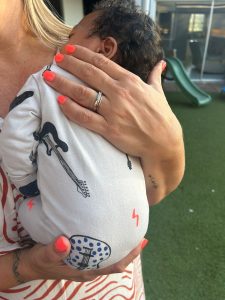
And that’s the issue of poverty: visibility. We have become so used to (or perhaps numb to) the vast inequality in our country, that the poor have become, invisible.
There are between 13.2 and 13.8 million South Africans living in extreme poverty. That’s between 23% and 25% of our population surviving on less than R760 a month. The official 2022 South African Census revealed that we have 55,719 homeless people. These aren’t just numbers. They are people. People like her.
What struck me most wasn’t her desperation. It was her determination. She didn’t want handouts. She wanted to get out of the cold, out of danger, out of a system that had failed her. All she needed was a chance. I couldn’t walk away.
I made a few calls, and within hours, some friends and I got her and her baby into temporary shelter. That same day, she sent me photos of her new room with a bed, a kitchen, and most exciting of all, a bath. Something so mundane to most of us, but to her, it was a symbol of safety, dignity and hope.
That’s when it hit me: how much we take for granted.
We complain about slow Wi-Fi, load shedding, traffic, or the fact that our favourite coffee shop ran out of almond milk. Meanwhile, there are mothers all over our country sleeping in bushes with their babies, praying they make it through the night without being robbed, raped, or worse.
We say “first-world problems” as a joke, but the contrast is real. While we bemoan what’s missing from our Uber Eats order, someone else is wondering if they’ll eat at all. This isn’t about guilt, it’s about awareness. It’s about deep gratitude for all we have.
Gratitude provides a very profound perspective shift. We need to start acknowledging with gratitude what we’ve normalised as “basic,” because for many, these basics are unattainable luxuries:
- I’m grateful I have a roof over my head.
- I’m grateful my children are safe tonight.
- I’m grateful for hot water.
- I’m grateful for clean clothes.
- I’m grateful for a full tummy.
These aren’t small things. They’re everything. What if we began seeing the hardships all around us, rather than only seeing it when it’s shared on social media or turned into a charity campaign? What if we stopped walking past people without seeing them and acknowledging them?
Because the moment we sit down beside someone, make eye contact, and say, “I see you,” everything changes. They become a mom like us; a sister like us; someone as deserving as us of a life of dignity.
Gratitude doesn’t solve poverty. But it can create empathy. And empathy leads to action.
The truth is that South Africa is overwhelmed by poverty. This doesn’t mean we shouldn’t hold government to account to fix the systemic causes of this inhumane scourge. But it asks that we as ordinary citizens, start filling the gaps wherever we can.
You don’t need to be a millionaire to make a difference. Sometimes, all it takes is a meal, a blanket, a lift to a shelter, or stopping long enough to smile, or say hello.
The next time we are tempted to grumble about life’s inconveniences, let us remember this mother and her baby. Let us remember that “luxury” is often nothing more than a warm bath and a door that locks.
Just seeing someone might be the most powerful act of kindness and humanity we ever offer.
About The Author
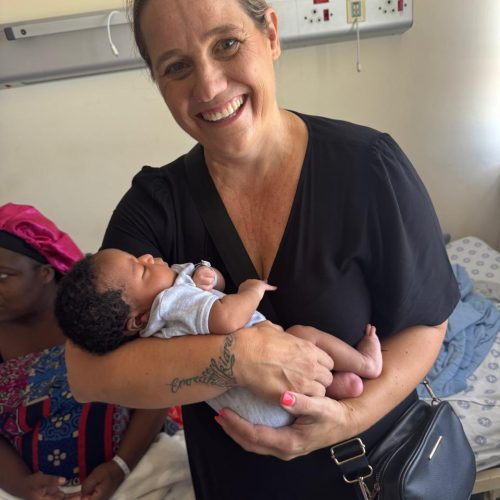
Joanne Teunissen is an advocate for vulnerable women and children, the director of the Durban North Baby Home, a place of safety for abandoned and vulnerable babies. She is also a founding member of Baby Line, a national counselling service for vulnerable women. With a deep belief in love, dignity, and second chances, Joanne and her team work to ensure that every child and every mother is seen, heard, and valued. To support or learn more, visit www.babyhome.org.za